
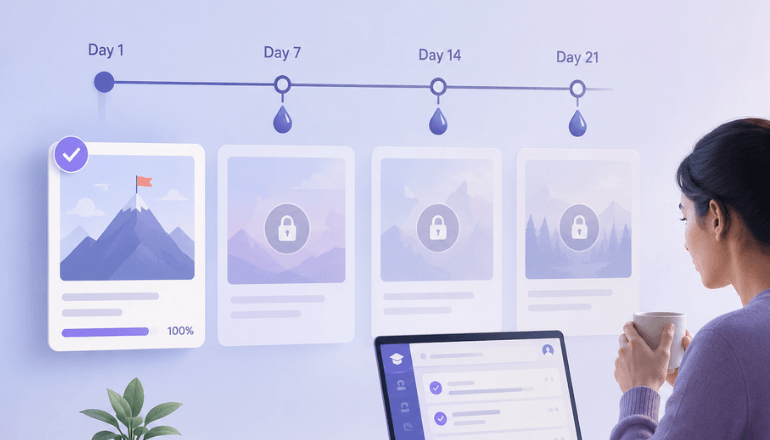
Give someone a full course on day one, and most of it goes unused. Not because the content is bad, but because access without pacing rarely turns into progress. Drip scheduling — releasing course content gradually instead of all at once — exists to solve exactly that problem, and it's one of the more underused features on most LMS platforms.
Here's what it actually does, when it helps, and when it gets in the way.
What drip scheduling actually is
Drip scheduling controls when a learner gets access to each piece of a course, rather than unlocking everything the moment they enroll. Instead of a full course sitting open on day one, modules release on a schedule — by calendar date, by time elapsed since enrollment, or by requiring the previous module to be completed first.
The name comes from the idea of content arriving in a steady drip rather than a flood.
Why pacing changes outcomes, not just structure
The value of drip scheduling isn't really about withholding content. It's about what pacing does to how people actually engage with training.
It prevents front-loading and abandonment. Given a full course at once, many learners binge the first module or two out of initial motivation, then never come back. Spreading access out gives the content a reason to keep showing up in someone's week, rather than competing entirely with day-one enthusiasm.
It matches cohort-based and compliance training to real timelines. Onboarding programs, certification tracks, and compliance training often need to happen over a set period — a 30-day onboarding plan, a quarterly compliance cycle — not compressed into a single sitting. Drip scheduling lets the platform enforce that timeline instead of relying on learners to self-pace correctly.
It creates natural checkpoints for support and grading. If content releases weekly, instructors and admins get a natural rhythm for checking in, grading submissions, or answering questions tied to that week's material, rather than fielding questions about ten different modules simultaneously.
It reduces overwhelm for genuinely long courses. A course with forty lessons looks a lot less daunting five lessons at a time than as one long list on day one.
The two common ways to configure it
Date-based release. Content unlocks on fixed calendar dates or a fixed number of days after enrollment — module two available seven days after signup, module three after fourteen, and so on. This works well for cohort training where everyone should move at roughly the same pace together.
Sequential/completion-based release. The next module unlocks only once the current one is marked complete (or a quiz is passed), regardless of calendar date. This suits self-paced learners who move at their own speed but still need to progress in order — useful when later material depends on earlier material actually being understood, not just accessed.
Some platforms support both and let you mix them: sequential unlocking within a module, with an overall calendar cap so a course doesn't stretch indefinitely for a slow learner.
When drip scheduling helps, and when it doesn't
Drip scheduling earns its place in structured programs — onboarding, certification tracks, cohort-based training, anything where pacing matters as much as content. It also helps with genuinely long courses where day-one overwhelm is a real risk of drop-off.
It's less useful, and sometimes actively counterproductive, for reference material learners need to search and dip into as needed — a policy manual, a searchable knowledge base, anything meant to be consulted rather than progressed through linearly. Gating that kind of content on a schedule just adds friction to something that should be immediately accessible.
What to look for in a platform
If pacing matters for your training programs, a few things are worth checking beyond "does it have drip content" as a checkbox feature:
- Can release be based on calendar date, days-since-enrollment, and completion of prior content — or only one of those?
- Can different groups or cohorts run on different release schedules within the same course, or is pacing set once for everyone?
- Can an admin manually override and unlock content early for a specific learner without changing the schedule for everyone else?
- Does the learner see what's coming next, or does upcoming content stay fully hidden until release?
That last point matters more than it seems. Learners who can see a locked module with its release date tend to stay more engaged than learners who have no idea how much content is left or when it's coming.
Leave a Reply