

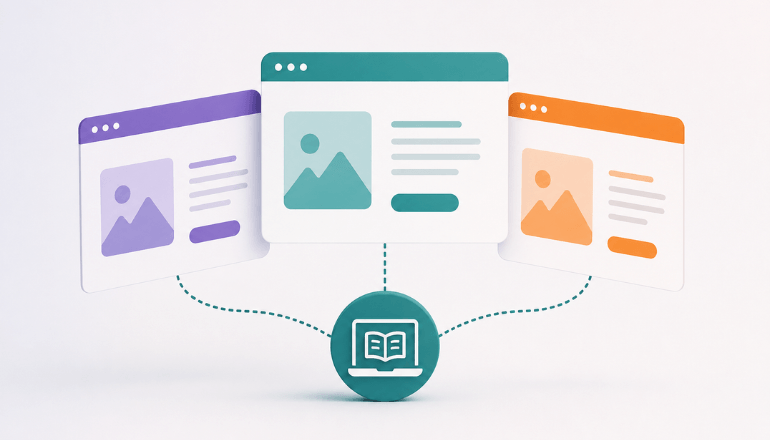
When people hear "landing page," they often think they only need one.
In reality, creating several landing pages for the same course or product can be one of the most effective ways to reach different audiences, improve search visibility, and increase conversions.
The course itself doesn't have to change. What changes is how you present it to people with different goals, interests, or levels of familiarity.
Different audiences respond to different messages
Imagine you're selling a leadership course.
A first-time manager may be looking for practical guidance on leading a team, while an HR director may be interested in employee development at scale. The underlying course can meet both needs, but the messaging that resonates with each audience will likely be different.
Creating separate landing pages lets you tailor headlines, descriptions, testimonials, and calls to action without duplicating the course itself.
Better opportunities for search engine optimization
Each landing page can target a different search intent.
For example, if you offer a project management course, one page might focus on "project management training for beginners," while another emphasizes "project management certification preparation." Both pages promote the same content but address distinct keywords that potential learners are searching for.
This approach expands your visibility in search results without forcing a single page to rank for every possible phrase.
Marketing campaigns become more effective
Not every visitor arrives from the same source.
Someone clicking an email campaign may already know your brand, while a person coming from a social media advertisement may be discovering you for the first time. Visitors from a webinar might expect different information than those arriving through a search engine.
Dedicated landing pages allow you to align your messaging with the campaign that brought people there, creating a more relevant experience and often improving conversion rates.
Test what works without changing your course
Marketing is rarely perfect on the first attempt.
Having multiple landing pages gives you the freedom to experiment with different headlines, layouts, value propositions, or pricing presentations. You might discover that one version appeals more to entrepreneurs while another performs better with corporate clients.
Over time, these insights help you refine your messaging based on real results instead of assumptions.
Highlight different benefits
The same product can solve different problems.
An online communication course, for example, might be promoted as a way to improve workplace collaboration, prepare for leadership roles, or build confidence in presentations. Each benefit may resonate with a different audience segment.
Rather than trying to emphasize every possible advantage on a single page, separate landing pages allow each message to remain focused and persuasive.
Support different stages of the buying journey
Some visitors are ready to enroll immediately. Others are still researching options.
A landing page aimed at beginners might spend more time explaining the problem and introducing your approach. Another page intended for returning visitors might focus on testimonials, advanced features, or enrollment details.
Meeting people where they are can make your marketing feel more relevant and less overwhelming.
Create location- or industry-specific pages
If your course serves multiple industries or regions, dedicated landing pages can speak directly to those audiences.
For instance, a business consultant might create separate pages for healthcare organizations, financial services firms, and technology companies while offering the same underlying training program. Likewise, localized pages can address country-specific terminology or examples without requiring separate courses.
This strategy makes your offering feel more tailored without increasing the complexity of course management.
Use landing pages to organize promotions
Seasonal campaigns, partnerships, webinars, and affiliate programs often benefit from their own destination pages.
Instead of sending every visitor to a generic sales page, you can create targeted experiences that match the specific promotion, including custom messaging or limited-time offers while keeping your primary course unchanged.
When the campaign ends, the landing page can be updated or reused for future initiatives.
How eProfessor helps
With support for multiple landing pages, eProfessor allows educators, coaches, consultants, and businesses to present the same course or product in different ways without creating duplicate content behind the scenes.
You can tailor messaging for specific audiences, marketing campaigns, or search keywords while managing a single course experience. That flexibility makes it easier to experiment with positioning, improve discoverability, and connect with learners who have different goals.
Final thoughts
Creating multiple landing pages isn't about making your marketing more complicated. It's about making it more relevant.
Different visitors have different motivations, and a page that speaks directly to those motivations is often more effective than a one-size-fits-all approach. By tailoring your messaging, targeting specific search intents, and testing new ideas, you can attract a broader audience and improve conversions without rebuilding your course or product each time.
Leave a Reply