
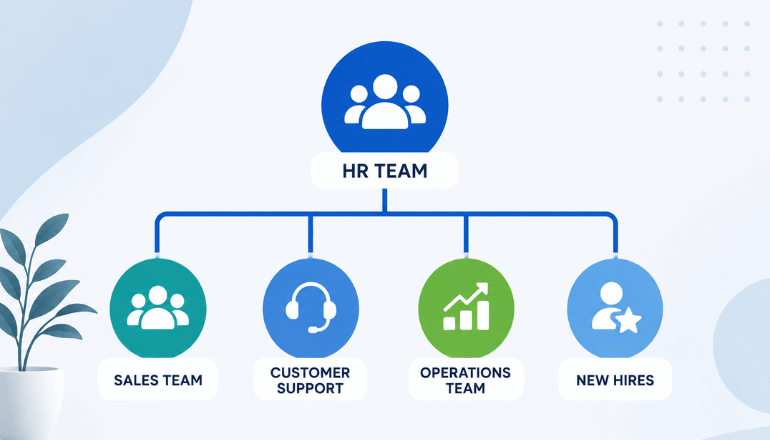
Assigning training one employee at a time works fine at ten people. At two hundred, it becomes a job in itself. Group-based learner management exists to fix exactly that scaling problem, and for HR and L&D teams managing anything beyond a small team, it's less a nice-to-have feature than the difference between training software that scales and one that doesn't.
What group-based management actually means
Instead of assigning courses, tracking completion, and managing access for each employee individually, group-based management lets you organize learners into groups — by department, location, role, hire date, or any structure that matches your organization — and then manage training at the group level.
Assign a compliance course to the entire "Warehouse Staff" group instead of two hundred individual employees. Pull a completion report for "Sales — West Region" instead of manually filtering individual records. Add a new hire to the "New Employees" group and have them automatically enrolled in whatever that group is assigned, rather than manually assigning each course one by one.
Why this matters more as headcount grows
At very small scale, individual assignment is manageable, if tedious. The value of group-based management shows up specifically as an organization grows, in a few concrete ways.
Bulk assignment saves real time. Assigning a new compliance requirement to five hundred people individually isn't just slower than assigning it to a group — it's a different order of magnitude of work, and it's the kind of task that becomes someone's entire afternoon instead of a two-minute task.
Reporting matches how the business actually thinks about training. When a compliance officer asks "which departments still need to complete the new safety training," the useful answer is a department-level breakdown, not a spreadsheet of every individual employee that needs to be manually grouped after the fact. Group-based reporting gives you that breakdown natively.
Onboarding gets automated instead of manual. New hires can be added to a group tied to their role or department and automatically receive whatever training that group requires, rather than someone remembering to manually assign the right five courses to every new employee individually.
Access control becomes structural, not ad hoc. If a specific course should only be visible to a specific department or region, group-based access enforces that as a rule rather than relying on someone remembering not to assign it to the wrong people.
Org changes don't mean redoing everything. When someone changes departments, moving them between groups updates their training requirements and access automatically, instead of requiring a manual audit of everything they were individually assigned.
What good group management looks like in practice
Not every platform's version of "groups" goes deep enough to actually deliver these benefits. A few things worth checking:
Nested or overlapping groups. Can someone belong to multiple groups at once — "Sales," "West Region," and "New Hires" simultaneously — with training requirements from each applying together? Rigid, single-group-only systems tend to force awkward workarounds once an organization's structure gets more than one dimension.
Bulk actions beyond just assignment. Can you bulk-enroll, bulk-remove, bulk-message, and bulk-report on a group, or does the "group" only apply to some of these actions and not others?
Automatic enrollment rules. Can new members added to a group be automatically enrolled in that group's required training, or does every addition still require a manual assignment step?
Group-level reporting that's actually useful. Does the platform show completion rates, average scores, and outstanding requirements rolled up by group — the view an HR or compliance manager actually needs — or does it only offer individual-level data that has to be manually aggregated?
Reasonable import and sync options. Can groups be built from a CSV import or synced from an existing HR system, or does every group have to be built by manually adding people one at a time inside the platform?
The bottom line
Individual learner management works until it doesn't, and the point where it stops working tends to arrive faster than expected — a compliance deadline, a fast-growing headcount, a reorg that touches training assignments across the company. Group-based management isn't really an advanced feature; it's the baseline requirement for HR and L&D software to actually scale with an organization instead of becoming more work as the organization grows.
See group-based learner management in eProfessor
Leave a Reply